Friday, September 10, 2010

A Woman's Best Ornament

I had to read this one slow in order to fully understand everything. Unfortunately my vocabulary isn't quite as vast as I may always like and so I had to look up quite a few words. Unless I missed something I would say I agree with this article. ~ Barbara Anne


GODEY'S LADY'S BOOK
 February 1850
WOMAN'S BEST ORNAMENT
BY REV. B. P. ROGERS.

LET me urge upon my female readers, especially those who are in youth, the importance of taking loftier and better views of life than those taught by the vain world. It is a sad thing to see so many of the young and fair, whose life is most a blank—I will not say a blot—whose keen susceptibilities, whose noble powers, whose deep affections, whose precious time is lavished only upon dress and gayety, and fashionable visiting; who wear the bright apparel of the butterfly, and are as light and graceful, and as useless too; whose conversation finds no higher or more improving subject than the idle gossip of the day, the last party, or the never-failing topic—dress; whose reading is the miserable trash which is inundating every community, and enervating and dissipating the minds of our youth; whose whole life seems to be an aimless, frivolous life; and who, as they flit by us on their airy wings, provoke the inquiry: "For what were these pretty creatures made?"—I pray you, take loftier views of life than these. While I would not draw yon from the rational pleasures of society, nor bring one gloomy cloud upon your youthful sky, I still would plead for some serious hours, some industrious moments; some time apportioned to the culture of the mind, the enriching of the memory with stores of useful knowledge. I would plead that the capacities and aspirations of the immortal part receive some ministration, and that the moral faculties be cultivated and stimulated, and the generous impulses of the soul be expanded in labors for the best good of those around you. Be assured there is no beauty like that of goodness—there is no power like that of virtue; personal beauty may attract the admiration of the passing hour, but it is the richer beauty of moral worth, the loveliness of the soul, that commands the deepest reverence, and secures the most enduring affection. Even men who have no religion themselves, but who are men of judgment, and whose opinion is worth the most, respect and admire a lady most, who displays in her character the " beauty of holiness."If there is one sight more than any other, in this world of sin and sorrow, which combines all the elements of beauty, of nobleness, and of worth, it is that of a young and lovely female, whose youth and beauty, whose depth and richness of affection, and whose powerful influence on human hearts, are all consecrated to the cause of truth and holiness, laid as an humble offering at the Saviour's feet! Such a being is, indeed, worthy of the reverence and admiration of every true and noble heart; and she will command it, even when the light of her beauty is quenched, and the flower of her loveliness is faded. But if there is a sad, heart-breaking sight on earth, it is that of one gifted with all the charms which nature lavished upon her daughters, prostituting them upon the altar of vanity or fashion, and starving the soul on the unmeaning flattery of a vain and hollow-hearted world; running a giddy round of' gayety, frivolity, and dissipation; laying up in the future a cheerless and forsaken old age, and a miserable, remorseful eternity.

"Oh, what is woman? What her smile,
Her lips of love, her eyes of light?
What is she, if those lips revile
The lowly Jesus? Love may write
His name upon her marble brow,
And linger in her curls of jet:
The light spring flowers may meekly bow
Before her trend; and yet – and yet
Without that meeker grace, she'll be
A lighter thing than vanity !"

Children's Costumes


GODEY'S LADY'S BOOK
Philadelphia, January 1850

CHILDREN'S COSTUMES FOR FANCY PARTIES.


THE expediency of children's parties is a question not yet set at rest by the magazines and journals devoted to nursery tactics; but as, in the mean time, children will enjoy themselves after this fashion, and there are mothers indulgent enough to gratify them, we give a plate of some of the prettiest costumes Parisian taste and elegance have copied or invented. Those who are anti to these amusements, can but acknowledge that, apart from all interest as a model, the plate possesees much merit as a picture. It is in this the French excel so wonderfully; and by this test, a real French fashion plate is easily distinguishable. The figures are not placed merely as wooden blocks to support the costumes, but are pretty women and graceful children – grouped effectively end naturally. How different from the coarse, native imitations one frequently sees in the cheap magazines; where two tall, stiff females stand bolt upright, doing nothing, staring at space, and as unlike real life or animate beings as were the performers in Mrs. Jarvis's "wax-work show." It is useless to deny it; from the days of the Virgin Queen to our own time, the French, and they alone, have set the fashions for half the world. And no wonder, for their artistes compose, and are well paid for their genius as well as their time. In this group, for instance, note, if you will, the stateliness of the miniature Queen Bess, in her rut and brocaded gown. With what an air of majesty she surveys her little subjects, listening while the hurdy-gurdy girl presents her petition! The wandering minstrel herself, whose eloquence has affected Titania to a half-sorrow-ful silence, while she leans gracefully upon the arm of that spruce young pilgrim! The peasant girl, at the head of the group, is evidently considering how much of the coin jingling in her apron pocket she can afford to bestow; and the tiny, crimson-robed maid of honor, perhaps, wishes she could afford to be liberal. The salaries of these demoiselles are never too large, as we all know. Last, but not least, Tom Pouce, mounted on his green-velvet footstool, attired as a gentleman of the old school, is stretching forward his little head, as if he would like to know what all this fuss is about. These costumes, though, at first sight, seeming so costly, can be easily arranged at very little expense. Any mother, with ordinary taste and ingenuity, could do so with few purchases; and, as the dress is worn but once or twice at most, there is not much matter about the length of stitches. Indeed, a very pretty costume has been finished with the aid of pins alone. " Grown-up" parties are relieved of much stiffness by the present fashion of fancy costumes; and either of those given for children, can be made to suit older people.


Thursday, September 9, 2010

Girls Dresses


sorry... I have no clue how to flip the photo :) from Godey's Mag. 1857
ref="http://books.google.com/books?id=Y8hMAAAAMAAJ&pg=PA95&ci=488%2C147%2C431%2C1010&source=bookclip">

Sunday, September 5, 2010

Kinds of Dresses

Image from Godey's Lady's Book Dec. 1857 pg.541

House Dress: A dress worn only at home. The plainest style of dress it should be comfortable and as sensible as fashion allows. Has long sleeves, high neckline, subdued colors, and little to no decoration.

Toilette de Reception: A more elaborate version of the house dress for receiving visitors. As visitors not always announced themselves and house dresses were equally acceptable for the occasion, dedicated reception toilettes are relatively rare. Politley subdued elegance to shows respect for the visitor.

Visiting Dress / Toilette de Visite: Worn for paying visits to other people during the daytime. Politely subdued elegance that should not embarass the hostess. As visiting others involved a certain amount of staying outdoors on the way there, the visiting dress reflects seasonal changes to a certain extent but doesn't incorporate warm overgarments (which are add-ons rather than part of the dress) as they are meant to be discarded upon arrival. Worn with a hat or bonnet.

Walking Dress / Promenade Dress / Toilette de Promenade: As the name implies, it is an outdoor garment worn for walks. It therefore reflects seasonal change to a great degree, incorporating warm overgarments such as coats or mantillas into its very design as they are not meant to be seen without the overgarment. Summer walking dresses should have a parasol to go with it. Worn with hat or bonnet.

Carriage Dress / Travelling Dress / Toilette de Voyage: A garment for traveling. As outdoor garments, they reflect seasonal change to a certain degree and are worn with hats or bonnets. The emphasis is on practicality: avoiding problems with getting off and on coaches, ease of cleaning, colours on which dust isn't too conspicuous.

Riding / Equestrian Dress: The only dedicated sports garment until the late 19th century. Evolved from 18th century hunting garments, which, from the very beginning on, imitated male dress - the jackets. Forest colours, black and red are favoured. No-nonsense garments without skirt supports, made of fabrics that can take a twig or thorn. Worn with hats.

Dinner Dress: Worn during the late afternoon, e.g. for dinners in public. High degree of elegance and formality, showing off the wearer's good taste and the seamstresse's art. Neckline often lowered but not low, sometimes short sleeves.

Evening Dress / Toilette de Soirée: Dress for evening occupations such as formal Diners, concerts, theatre, parties. High elegance emphasising the wearer's beauty, wealth and decency. Colourful, low necklines, short sleeves, lots of decoration. It's difficult to draw a line between evening and ball dress.

Ball Dress: Highest degree of elegance (a lady's best dress), meant to show off the wearer's beauty and wealth. Low neckline, short or no sleeves, lots of decoration, tight bodice.

Wedding Dress: It was fashionable to marry in white. Until the late 19th century, wedding dresses usually had high necks and long sleeves. Even if they were white, they could later be worn as visiting or dinner dresses as their cut didn't deviate from the current fashion.

~ adapted from "Kinds of Dresses" at http://marquise.de/en/1800/glossar.shtml

Monday, August 30, 2010

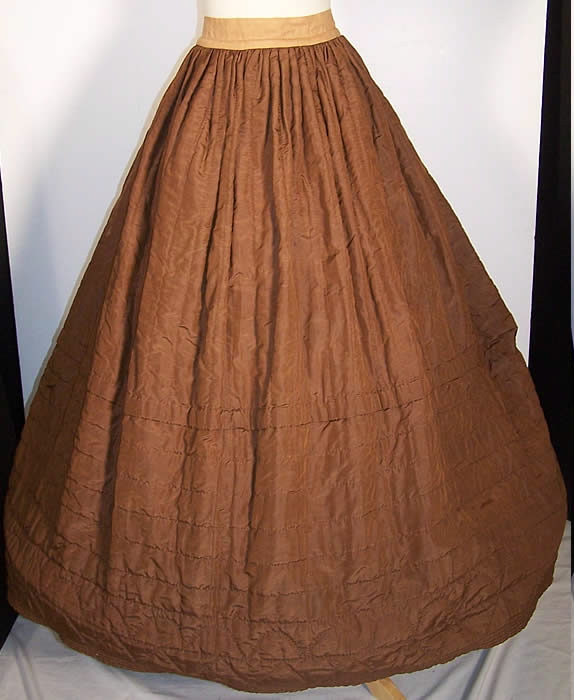
Brown Silk Quilted Petticoat 1840's

This brown silk quilted petticoat skirt is from the 1840's is all hand stitched and made of a chocolate brown silk fabric. The waist treatment is cartridge pleating. It has a decorative hand quilted striped scalloped design along the bottom done in tiny even stitches. This wonderful winter petticoat has a full hoop skirt, is fully lined with a polished brown cotton fabric and has a wide linen waistband that someone has added a gray linen tie back closure. The petticoat measures 38 inches long, with an adjustable 30 inch waist.


Green Quilted Silk Petticoat 1840's

This green silk quilted petticoat skirt dates from the 1840's. It is all hand stitched and made of a pale celadon green silk brocade fabric with a raised swiss dot pattern. The waist is knife pleated. The bottom of the skirt has a decorative hand quilted garland leaf design. The winter petticoat has a full hoop skirt, is fully lined with a polished brown cotton fabric and has a linen waistband with no closure on back. The petticoat measures 40 inches long, with a 25 inch waist.


1840's Brown Calico Dress

Antique early roller print brown calico dress from the 1840s. It is all hand stitched and made of a brown calico fabric with a roller print red floral pattern design. The bottom 9 inch hemline of the skirt is lined in an indigo blue and white calico fabric. The work dress has a pleated front bodice with long narrow sleeves and a ruffled trim at the elbows. It has cartridge pleats around the waist and a full hoop skirt. The inside bodice is lined in a homespun linen, with an attached inner cotton modesty panel across the bust with brass hooks & eyes for closure down the front. The dress measures 52 inches long, with a 26 inch waist, 34 inch bust and 13 inch back.


Wednesday, August 25, 2010

Two Styles of Undergarments for Children

From Godey's Lady's Book ~ August 1861


Godey's recommends figure 8 to be one of the neatest and most serviceable style of undergarments for children. Note the flat-felled seams. ~Barbara Anne

Monday, August 23, 2010

A Must Read Article on Dressmaking! (1856)

From The Lady's Guide to Perfect Gentility By Emily Thornwell (Pages 221-226)

DRESSMAKING.

General facts and rules to be remembered.—Some few things are true about the making of all skirts, through every change of fashion, and whether the dress be of the coarsest stuff or the richest satin.

In cutting off the breadths, be careful to have them all of precisely equal length; also see that regard is paid to the figure running up or down, when the breadths are being basted, previous to running them. This is a matter that is frequently overlooked, even by experienced dressmakers. The breadths should be basted or pinned securely while running them, because a puckered' skirt will spoil the appearanceof the most elegant dress. Commence running each breadth at the bottom, first measuring off a length of silk sufficient to prevent the necessity of making any breaks of any sort in the seam. Not one back stitch can be permitted, as it will show distinctly on the right side, especially if the material be stiff silk.

The fastenings of the dress should be sewed on with great care, so that they may last as long as the dress itself. Whalebones should be smoothly pared on the edges and ends, to prevent them from slipping out after wearing holes in the waist-lining.

Obtaining the materials.—First the materials for the intended dress must be procured, and it is advisable, whenever practicable, to get them all at the same time. The necessary requisites are the mate: rial, the lining for the body and skirt, wadding, covering, hooks and eyes or buttons, whalebones, silk and thread. These are all required for a silk dress, and most of them for dresses of other fabrics.

Cutting the dress.—Having thus procured the required articles, proceed to cut out the dress, first measuring off the number of breadths of the proper length for the skirt. These must be immediately sewed over the edge to prevent their ravelling out. If tucks are intended, a proper calculation must be made as to their width, previous to cutting the breadths.

Next cut out the sleeves by the paper pattern which you have previously provided. Double the lining and cut it out according to your paper pattern. If you design the sleeves to be cross-way of the cloth, see to it that it is cut exactly cross-way, as also should be the outside, or they will draw when the dress is finished.

Measuring and fitting.—The skirt and sleeves being thus prepared, proceed to take the proper measures for the front and back of the body, by fitting a pattern to the shape of the person for whom it is intended. This pattern may be of thick paper, or what is better, thin white cloth. Pin the straight edge of the paper to the exact front of the body, letting it lie smoothly as possible over the bosom, and extending as far as the shoulder, where the paper may be secured by a pin, Lay three folds of equal breadth under the bosom, for biases. Pin these carefully, as much of the beauty of the waist depends upon them Then pare out the neck, and arm, and cut off the bottom of the waist to suit your taste, with either a long or short bodice. Fold over an inch on the straight side of another piece of paper, and pin it up and down the back. Cut it to fit, and meet the front piece at exactly the side of the body. You will then have an exact pattern of one half the waist.

Cut the lining of the waist by the pattern thns obtained, and exit the silk material by the lining. It is not generally advisable to cut out the half of the back all in one piece, as it fits better with pieces joined at the sides ; they are called side-bodies; and this method should always be adopted, unless the lady has a very flat back; in that case it is best . to cut the half all in one piece.

Running or seaming the breadths.—Be sure that the skirt is quite full, as narrow skirts are now completely exploded. Fasten the edges of the breadths to your knee, or to a pincushion screwed to the work-table, to hold them firmly. Run the lining together in a similar manner, and fasten each of the outside seams to a corresponding one in it, after which overcast the top and bottom edges. An opening must be left in one of the seams for the pocket-hole, which must not exceed one quarter of a yard in length.

Having thus completed the skirt, to which flounces may be added, or into which tucks may be introduced, if deemed advisable (they seldom are in silk dresses), you proceed to make the sleeves, and trim them before stitching them into the waist.

Baste securely the parts of the waist and try it on, for the purpose of perfecting it as to its fit. Then cord the neck, arms, and other parts. Plain sewing is now all that is required to finish the waist ready to be placed upon the skirt. Turn the skirt in at the top till it is of the proper length, both behind, before, and at the sides. Gather or plait the skirt, according to the prevailing style in this respect.

Capes to dresses are often very desirable, made of the same material. They are very convenient articles; and no great art, though a proper degree of attention, is required to make them neatly. The lining is to be tacked to the silk or stuff, and the cape cut out by a paper pattern the size and shape required. Before taking out the tacking thread, a cord should be run in at the edges, and these latter are to be turned, and the fining sewed down firmly upon them. You now take out the thread, and ornament or leave the cape plain, as you please.

In making flounces, be sure that they are cut precisely cross-wise of the material, otherwise they will hang ungracefully. Sometimes fashion dictates straight-way flounces; they are more easily made than those cut cross-way, but are not so elegant, except as fashion rules.

Tucks, with or without open-work between them, have an exceedingly neat appearance, and are seldom out of fashion. They are especially proper in white and black dresses.

It is sometimes good economy to make the sleeve of a dress in two separate parts, so that the lower portion can be taken off at pleasure. For an evening dress this is found very convenient, as when the under part is removed, a lace can be placed upon the short sleeve, thus giving a very dressy and tasteful appearance.

Silk and other heavy dresses should be lined, but muslins and calicoes look better when hemmed at the bottom of the skirt.

It is a good plan to set a worsted braid around the inside of the bottom of nice dresses, of the same color, and projecting one quarter of an inch below the material. Much wear is thus avoided, and the braid can easily be replaced.

We have been thus explicit with regard to the minutiae of dressmaking, hoping that we might add many to the present number of ladies whose interest and pleasure it is to be their own dressmakers.


Thoughts on Stays ~ 1856

From The Lady's Guide to Perfect Gentility By Emily Thornwell (Pages 132-137)

EFFECTS OF DRESS UPON THE FEMALE FORM, ETC., ETC.

Lacing the chest.—When the breathing is deep and full, the chest is expanded and rises, and the stomach is protruded during inspiration, while the chest falls and contracts, and the stomach recedes during expiration. Now what must be the effect of preventing these movements of the chest and stomach by means of a tight bandage? Why, the lungs can be distended no longer with air, the breathing becomes hurried by the least exertion, the natural functions of the organs occupying the interior of the body are hindered, and the free circulation of the blood impeded, constituting, altogether, ample causes of disease.

When the chest is scientifically laced as tight as can be borne, it often causes the blood to rush to the face, neck, and arms, on taking exercise or remaining in a heated room. Young ladies at parties frequently become so suffused from this cause, that they present the appearance of a washerwoman actively engaged over a tub of hot suds. Tight lacing also causes an extreme heaving of the bosom, resembling the panting of a dying bird.

Effect of tight lacing on the face, neck, arms, shape, and motion of the body, etc.—Those who wear very tight stays complain that they cannot sit upright without them ; nay, are sometimes compelled to wear them in bed, and this strikingly proves to what an extent artificial braces of any sort weaken the muscles of the trunk. It is this which disposes to lateral curvature of the spine. From these facts, as well as many others, it is evident that tight stays, far from preventing the deformities which an experienced eye might remark among ninety out of every hundred young girls, are, on the contrary, the cause of these deviations. Stays, therefore, should never be worn, under any circumstances, till the organs have acquired a certain development ; and they should never at any period be tight. A well-known effect of the use of stays is, that the right shoulder frequently becomes larger than the left, because the former, being stronger and more frequently in motion, somewhat frees itself, and acquires by this means an increase of which the left side is deprived, by being feebler and subjected to continued compression.

The injury does not fall merely on the internal structure of the body, but also on its beauty, and on the temper and feelings with which that beauty is associated. Beauty is in reality but another name for that expression of countenance, which is the index of sound health, intelligence, good feelings, and peace of mind. All are aware that uneasy feelings, existing habitually in the breast, speedily exhibit their signature on the countenance, and that bitter thoughts, or a bad temper, spoil the human face divine of its grace. But it is not so generally known that irksome or painful sensations, though merely of a physical nature, by a law equally certain, rob the temper of its sweetness, and, as a consequence, the countenance of the more ethereal and better part of its beauty.

In many persons, tight stays displace the breast, and produce an ineffaceable and frightful wrinkle between it. and the shoulder; and in others, whom nature has not gifted with the plumpness requisite to beauty, such stays make the breasts still natter and smaller. Generally speaking, tight stays also destroy the firmness of the breast, sometimes prevent the full development of the nipples, and give rise to those indurations of the mammary glands, the cause of which is seldom understood, and which are followed by such dreadful consequences.

They also cause a reddish tinge of the skin, swelling of the neck, etc. A delicate and slender figure is full of beauty in a young person; but suppleness and ease confer an additional charm. Tet most women, eager to be in the extreme of fashion, lace themselves in their stays as tight as possible, and, undergoing innumerable tortures, appear stiff, ungraceful, and illtempered. Elegance of shape, dignity of movement, grace of manner, and softness of demeanor, are all sacrificed to foolish caprice.

Stays tend to transform into a point the base of the cone which the osseous frame of the chest represents, and to maintain in a state of immobility two cavities, whose dimensions should vary without ceasing. By this compression, stays are prejudicial to the free execution of several important functions, muscular motion, circulation, respiration, digestion.

The muscles, or organs of motion, are enlarged by free exercise, and are destroyed by compression; every degree of this, as exercised by stiff stays, diminishes and enfeebles the muscles of the chest; a great degree of it absolutely annihilates them. Long before that is accomplished, the stays become necessary for support instead of the muscles; but as their support is remote from the spine, as well as inadequate, it yields, and lateral curvature, or crooked back ensues. Ketreat to natural habits is now difficult or impossible; if the muscles retain any power, they increase the curvature, and the wretched being is reduced to the necessity of obtaining support, and maintaining existence, by stays still stiffer during the day, and at night by stays when in bed.

By impeding the circulation of blood through the lungs, the use of stays not only prevents their proper development, and renders respiration difficult, but becomes a predisposing cause of convulsive coughs, consumption, palpitation of the heart, and aneurism.

From the same cause, obstinate and dangerous obstructions in the abdominal organs, which are displaced by the pressure of the busk, are of frequent occurence. In females, the liver has frequently been found pushed several inches beyond the last ribs, and its superior surface perceptibly marked with them; and this has been produced solely by the pressure of the stays upon the organs contained in the chest.

Some additional reasons why tight-laced dresses should be avoided.—Any unnatural compression of the chest produces a narrowness of the parts, and permanently deforms it by doubling the cartilages of the ribs inward, near their junction with the breast bone.

In some persons who practice tight lacing with the indispensable accompaniment of the busk, a constant feeling of aching and soreness of the breast-bone is induced, and so severe does this become, that the removal of the* busk is attended with excruciating pain, and has to be effected gradually.

All the lower organs of the body, such as the liver, the diaphragm, the stomach and spleen, are prevented from performing each its important function; and who can wonder that cold extremities, pale visages, troubled sleep, excessive nervousness of the system, etc., are among some of the frightful consequences of this universal practice ?

Monday, August 16, 2010

Chemise Diagram

From Peterson's, December 1860

"Thinking that a pattern of under-linen would be exceedingly acceptable to many of the subscribers to Peterson's, we, this month, give one of a Chemise of the newest make. The back is straight, edged with a piece of work only; the front is trimmed with insertion, embroidery, and small tucks let in between the insertion. This trimming is of a pointed form; and the body of the Chemise in front must be cut the same shape, to fit on to this. The width of the long-cloth, or linen, is sufficient for the width of the garment, and should be gored at the top, the gores that are cut off being placed at the bottom, and the arm-hole shaped out. The sleeve is cut in two pieces, and should be joined together by a double row of stitching; it is made of Scotch cambric, with very small tucks run in it, to match the trimming in front. For strength and durability, we would recommend that this be made of the same material as the Chemise. As our space is limited, we have only been able to give, in the diagram, the half of both the back and front, as far down as the top of the gore; but the illustration of the garment itself will clearly show how it should be made. The front is gathered from A to B; the part from A to the bottom of the point, and the same from C to C, being put on quite plain; it is gored from D to E, and the gore that comes off is put on to the bottom. The back of the Chemise is plain from F to G; and the other portion of the back is gathered into the work on the top. It is gored from H to F; the gore that comes off being put on to the bottom, in the same manner as with the front gore."


Sunday, August 15, 2010

My Blue Ball Gown

It never fails, I don't think I have ever made a article of clothing for myself that is not blue (this is quite unconsciously I might add), there was that burgundy cape dress I made but I don't really wear it often, the sleeves just don't seem right to me. Sigh...

Anyway, back to the dress, So I knew exactly what I wanted the bodice to look like, short puffy sleeves, double darted bodice, I wanted the back to have a princess seam and a hook and eye closure. I was trying to decide between cartridge pleating, knife pleats, or double box pleats for the skirt and finally decided on double box pleats wrapping around the front and to the back with the very center back having small cartridge pleats to add extra fullness to the skirt.

my blue cotton fabric I bought at a amish quilt shop

the pattern I came up with after a couple of mock-ups (no the neckline is not it's finished size since I was not sure at first how wide I was going to end up making it)

front bodice before the dart were sewn

back bodice

back bodice side

The Curtain Gown


Ok, so I had 4 full days to make a ball gown with 2 curtains, some dark brown fabric and a bit of mustard colored fabric and... I must not forget, a good friend by my side who helped me so much more than she thinks! Ps. That ugly fabric didn't seem so ugly when the dress was done. In fact my friend looked very nice in it! Do you think?


My friend and I

mom and my friend

do you see her.................................^

working on the bodice

because of limited time I cheated and put an invisible zipper in... shhh!


knife pleating the skirt
Note: do you see a bolt of dark blue fabric in the back there?
I made "The Blue Ball Gown" with that fabric.

pleated, ready for the waistband

I wish I had more and better pictures. Oh well!

Sunday, August 1, 2010

My Civil War Era Corset, Simplicity 7215


~oOo~
Planning the Corset
Compare and Contrast with Simplicity corset patterns 7215 and 2890. I finally concluded on using pattern 7215, the one on the left. Though both the patterns were roughly similar I decided to go with 7215 because it was longer than 2890 and because I liked the way the pattern was to be constructed. (the gussets are sewn in between two pieces of fabric rather than the gussets being sewn into the body. I plan to make pattern 2890 in the future though, hopefully.

Making the Corset
corset inside front, gusset opening edges basted (above)


gussets pinned onto corset front right, right before laying corset front lining on top (above)


the two layers with gussets between (above)


a close up of the overcast stitching at the points of each gusset opening (above)


machine stitching around gussets, using the seam ripper to take out basting stitches (above)
Note: Machine sewing around the gussets in the above picture is not in the instructions for the corset. I sewed them in such manner for strength and because of this corset drawing.


applying the boning into the newly sewn channels (above)
Note: I used plastic wire ties for the boning.

Making the Eyelets
1. Mark the placement of the eyelets on the wrong side of your fabric.
2. Find an awl. I used an ice pick for making the holes since that was all daddy could find on his work bench that was anything close to what I was trying to describe. I found ice picks work perfect! In fact, it is now a member of my sewing box until daddy asks for it back. :)
3. form the hole (below)

4. sew small stitches around hole for a guide (below)
5. sew overcast stitches around hole until eyelet is complete (below)

What did I think of Simplicity pattern 7215?
Overall, I liked the pattern. I made a major adjustment from the start though. I made the corset without the bust closure option. (I didn't have a corset closure at home and I was not in a situation where I could run out and get one) I continued in making the corset according to the pattern i
nstructions. I found the bust was incredibly to big for me so I had to narrow the upper gussets. The hip size seemed to fit though now I think I should have adjusted the gussets there to be a bit larger. I also had to play around with the back gusset it being to large... For the eyelets down the back, I skipped every other one since I decided to hand stitch them. I had to play around when applying the front to the back to ensure a strait line running down the sides. I went to apply the boning columns but my sewing machine, being a cheap one from Wal-Mart, would not sew through all the fabric layers necessary to use that method! So.... I followed my imagination for the insertion of the boning. I inserted the boning between
the two layers of the corset by means of channels I sewed onto the corset body. You probably can tell more accurately how I did that from the pictures.

~oOo~
Pictures of it Completed!

Yeah, looks kinda weird over my every day clothing. My! I need to reshape the sizing of the boning on my hoop skirt.

NOTE:
Stephanie, from World Turn'd Upside Down made a corset with pattern 2890 I assume. (the other pattern I was thinking of using) She has a front closure on hers and she inserted her boning through applied channels. I assume her sewing machine actually works, unlike mine. :) To see it click here. Thanks for encouraging me Stephanie! Making the corset was not hard at all!